
In the sitcom version of America, healthcare is The Love Boat: always sailing, always sunny, and staffed by confident Docs with reassuring smiles and great hair. But what if the Love Boat were actually a WWI dazzle ship, painted in illusions to confuse the enemy, navigating treacherous waters with no clear heading? The cheerful exterior of the U.S. healthcare system masks an undercurrent of unpreparedness and strategic incompetence.
Rising Waters, Rising Costs
I watched the Saugatuck River, swollen with rain, rise 10 feet to touch the Post Road Bridge.
All along Connecticut coastlines and riverbanks, communities are flooding, affecting billionaires and baristas alike. This storm passed. In a few days, the Mr. and Mrs. Howells of Westport, no longer stranded on their insular Gilligan’s Island, forced to forage on gluten-free muffins and charcuterie, would be safely ensconced back in their tiny, tony town.

A hundred years ago, Zelda Fitzgerald spent the summer of 1920 in Westport: a glittering season in a gilded world, just this side of paradise. Today, the party’s over. The champagne is warm. The ice has melted. The Jazz Age has been replaced by the Age of Just Hanging On. What once felt timeless now feels terminal.
In the future, rising waters won’t recede but keep on keeping on.
As temperatures soar, rivers flood, and weather patterns become more erratic, healthcare faces extraordinary challenges. These challenges are no longer “unprecedented” since each successive climate calamity adds to an ever-growing list of “precedents.”
These clinical, financial, conceptual, and technical challenges will reshape healthcare costs and utilization patterns. We are navigating in uncharted waters, while the Titanic Love Boat (the US healthcare system) is constantly threatened, overwhelmed, and overturned.
The crew (healthcare providers) were once secure and smiling Docs on deck in a predictable, stable world.
But the horizon is darkening, the air is filling with particulates, and new infectious diseases are leaping species. Climate change is a causal storm that will batter our fragile ship with waves of new health issues and emergencies.

So Doc must adapt to polycrisis, faring through fires, floods, heatwaves, power outages, and new pandemics. Once the charming face of sun-drenched elective procedures, Doc is now rerouting care through flooded corridors and power outages.
At the same time, the price of keeping our Love Boat afloat is skyrocketing. The ship’s budget is a dazzling $4.3 trillion, almost 20% of US GDP. At least $1 trillion is waste, fraud, abuse, and “administrative complexity.”
These costs for care and crime affect everyone aboard—from Captain Stubing (policymakers and healthcare leaders) to the passengers and their dollars (seasick patients and the panicked public).
In future blog posts, I’ll go below deck and chart how climate collapse will fundamentally alter the map of our pricey coastline.
Higher spending and morphing healthcare utilization will require creative responses. I’ll explore ways to steer the Love Boat around these icebergs, rather than heading straight into them.
But first, we need to look closely at what’s ahead.
If poor King Aethelraed was eternally unraed, how unready is the American health system for the voyage that awaits?
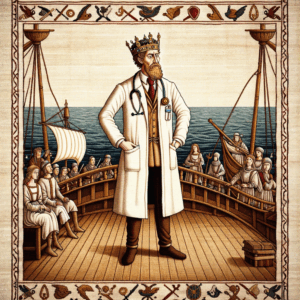
We are sailing into the future with no coordinates. And to make matters worse, Captain Stubing is not just unready, but unraed, in the Old English sense: badly advised, poorly led.
In defense of Aethelraed the Unready, he had a lot of bad advice. If you mix the most expensive healthcare system in the world with climate change, you would be unraed, too. The Love Boat is floating on current sitcom assumptions about public health and utilization.
Meanwhile, both climate policy and public health are increasingly under attack. Not just ignored, but criminalized. Try protecting air quality or reproductive rights in certain states. It’s not just hard. It’s against the law.
The Love Boat is drifting through shark-infested waters, commanded by the ghost of Æthelred and crewed by exhausted clinicians who know the storm is here but are told to keep smiling for the passengers.
Because if you’re sailing into a storm with a dazzle-painted hull and a hollow wheelhouse, you’d better know where the lifeboats are.
And someone . . . anyone . . .better start listening to the weather reports.